Lesson 17 of 64 Module 3: What is really happening inside
Why the same question gives different answers
After this lesson you can
- Explain why the answers change every time.
- Use that change as a free checking tool.
- Spot when a changed answer is a warning.
- Stop treating a new answer as a corrected answer.
Read first: It is guessing the next word
You asked an AI for the age limit on a form. Your friend asked the same thing on his phone, sitting next to you. The two answers do not match.
Now you do not know which one to believe. Neither phone is broken, and nothing is lying to you. This lesson shows you why the answers move, and how to make that work for you.
Why it never repeats itself exactly
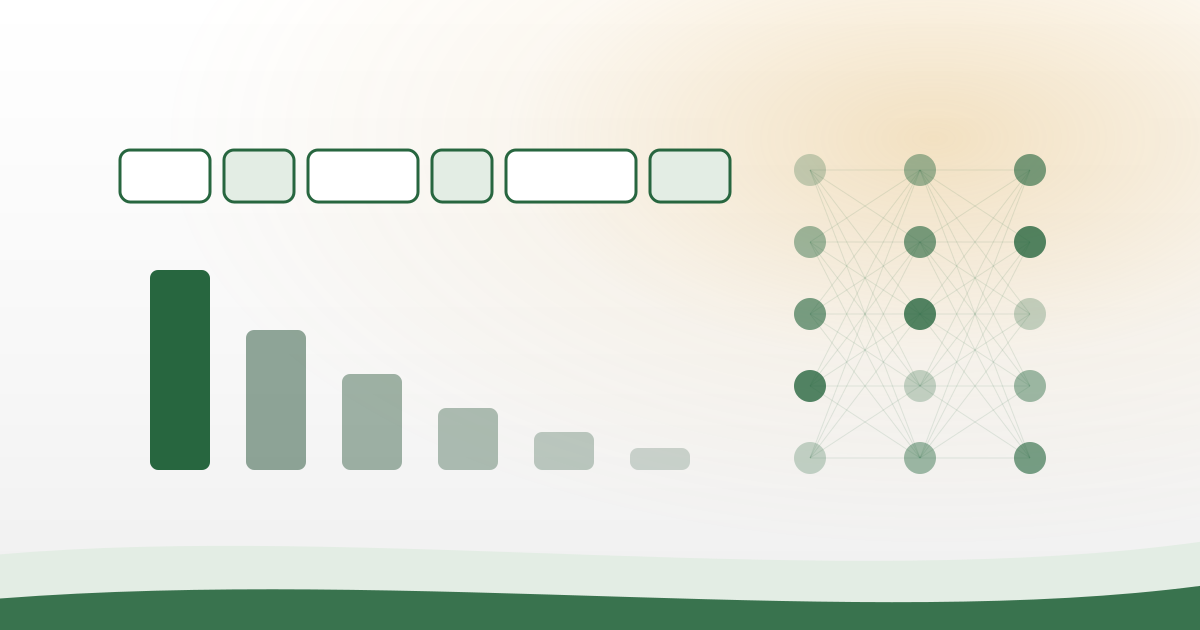
You met the main idea in it is guessing the next word. The model writes an answer one small piece at a time. At each step it works out a list of likely next pieces, with a score on each one.
Here is the part most people miss. It does not always take the top of that list. It picks from among the likely ones.
That looseness is on purpose. If it always took the highest score, the writing would come out flat and stiff. A small amount of chance is what makes the answer read like a person wrote it.
Some developer tools let you turn that looseness up or down. Most free chat apps show you no such setting at all. Do not hunt through the app for a slider. It is very likely not there.
So two people get two answers
Send the same question twice and it takes two different paths. Most of the time the only difference is the words. Same facts, new sentences, maybe a new order. That is harmless.
Sometimes the difference is the content itself. A different date. A different amount. A different name for the same office.
In a 2025 research paper, a team asked an AI for one person’s birthday. They asked three times and got three different dates. All three were wrong.
That is the case worth learning. The model was not lying on any of the three tries. It had no firm fact to give, so each try made a fresh guess. Why AI makes things up covers that habit in full.
No setting locks the answer
You may be hoping for a switch that makes it repeat itself. There is a setting that lowers the variation. Even at its lowest point, an exact repeat is not promised.
One big AI company says exactly that in its own developer notes. Researchers then showed why in 2025. They asked one large model the same thing a thousand times, with the variation turned right down. They still got 80 different answers.
The reason sits in the machines, not in the model. Your question is worked out on shared computers, next to many other people’s questions at the same moment. How many jobs run together changes the order in which the sums are added up. Tiny differences appear far past the decimal point.
Most of the time nothing shows. Once in a while a tiny difference tips one word choice, and every later word follows the new path. In that thousand run test, the answers stayed the same for about a hundred pieces of text, then split apart.
So do not type “always give me the same answer” and relax. Nobody can promise you that.
The two chat test
Now the useful part. This one habit is worth more than everything else on this page.
Take any question where a fact or a number matters. Ask it in one fresh chat. Then open a second fresh chat and ask exactly the same words.
What is the minimum age to apply for the SSC MTS exam?
Answer in one line.
Only answer if you are sure. If you are not sure, say "I am not sure".
That last line comes from research on how these models are graded. It is not a guarantee. It costs you one line, so it is worth adding.
Then compare the two answers. There are only two outcomes.
If they agree, treat the answer as likely. Not as settled. Both answers came from the same model, so both can be wrong in the same way.
If they disagree, neither one is knowledge. Stop there. Do not pick the one you liked better.
Two fresh chats matter. Do not send the question twice inside one chat. Inside a chat, the model can see its own earlier answer, because the whole chat is sent again on every turn. So the second answer is not an independent one. Why it forgets what you said explains that growing pile of text.
When to run the test, and when to skip it
Run it for facts and numbers. Dates, ages, amounts, marks, spellings, rules, a sum, the name of an office.
Skip it for writing. If you asked for a job application, a message to a customer, or a chapter explained in simple Hindi, two different versions are fine. That is the tool doing its job well. There you can run it twice on purpose and keep the better one.
It also helps to know which questions wobble most. A topic written about a thousand times over comes back steady. What a percentage is. Why the sky looks blue. The parts of a flower.
A rare, local, one off fact is the shaky kind. Your block office timing. One scheme’s exact amount this year. The pincode of a small village. If a fact was barely written down anywhere, the model has almost nothing to work from. It fills the gap with something that looks right.
| Your question | Test it twice? | Why |
|---|---|---|
| Explain reflection of light for class 10 | No | Two good explanations are both fine |
| The fee for a form this year | Yes | A number, and it changes every year |
| Write a leave letter for me | No | You want two versions, then pick one |
| Solve this sum and show the steps | Yes | Do the final maths on your calculator too |
| The last date to apply | Yes | Then confirm it on the official site |
The version that does not work
Most people do something else when an answer looks wrong. They stay in the same chat and type “are you sure?”. That is close to useless, and it often makes things worse.
Think about what the model can see at that moment. Your earlier question, its earlier answer, and now your unhappy line. No new fact about the world has reached it. Only pressure from you.
So it answers the pressure. Very often it says sorry and hands you a different answer. That change is not evidence. It does not mean the second answer is right.
This has been measured. A 2026 study gave seven strong models a well argued case for a wrong option, after each had answered correctly. The steadiest model still changed its answer in about one case in six. The weakest changed in almost every case.
The same trap works in reverse. Do not put your preferred answer inside your question. “The last date is 31 March, right?” pushes it to agree with you. Ask “What is the last date?” instead. It agrees with you far too easily takes this weakness apart properly.
If you really do have new information, that is a different thing. Then say what is wrong and give the correction. Correcting it when the answer is wrong gives you the words for that.
What to carry away
Variation is not a fault to be fixed. It is part of how the writing stays readable, and it is built in on purpose.
It also hands you a free tool. Two fresh chats, the same question, one minute. If the two answers disagree, neither is knowledge.
The next lesson looks at what thinking mode really does, and when turning it on is worth the wait. Later, in Module 4, the two chat test and three other checks adds three more checks. All four together take under two minutes.
Do this now
Ask your question twice, in two fresh chats
- Pick one factual question about your district, your exam or a form you have to fill.
- Open your AI app and start a new chat. Ask the question in one line.
- Write the answer in your notebook, word for word.
- Start a second new chat. Do not reuse the first one. Ask exactly the same words.
- Write that answer down too, and compare the two.
- If they disagree, mark the question as unanswered and go to the official website or the office.
Remember this much
- The model picks from among the likely next words. That is why the wording moves.
- New wording is normal. A new date, name or amount is a warning.
- No setting makes it repeat exactly, and nobody can promise you one.
- Ask a factual question in two fresh chats. If they disagree, neither is knowledge.
- Two answers that agree are a good sign, not proof.
- Never type are you sure in the same chat. It answers your pressure, not the facts.
Questions people ask
Why does ChatGPT give different answers to the same question?
Because it builds the answer one small piece at a time, and it picks each piece from a list of likely ones. It does not always take the top choice. That small amount of chance is put in on purpose, so the writing sounds natural instead of flat. So the same question can take two different paths.
Is the AI lying when the answer changes?
No. It has no plan to trick you. When it has a firm, well known fact, both answers usually carry the same fact in different words. When the two answers carry different facts, it means it never had a firm fact to give. Treat that as a signal to go and check, not as a lie.
How do I make AI give the same answer every time?
You cannot, and you should not chase it. Developer tools have a setting that reduces the variation, but even at its lowest point the answers are not promised to match. Your question runs on shared computers, and the order of the calculations shifts with how busy those computers are.
If I ask twice and both answers are the same, is it correct?
It is a good sign, not proof. Both answers came from the same model, so both can be wrong in the same way. Matching answers mean the question is worth trusting a little more. For money, medicine, law and government schemes, still confirm it on the official website or at the office.
Should I ask are you sure when I think the answer is wrong?
Not in the same chat. It can see its own earlier answer and your unhappy line, and nothing new about the world has reached it. Often it says sorry and changes the answer just because you pushed. Open a fresh chat and ask the same question in neutral words instead.
Prices, free limits and app screens change often. The facts in this lesson were checked on 9 August 2026. If what you see on your phone looks different, trust your phone and read the idea, not the exact button name.