Lesson 14 of 64 Module 3: What is really happening inside
It is guessing the next word
After this lesson you can
- Explain in your own words what the machine is doing.
- Say what a token is and why it matters.
- Understand why it never says I do not know by default.
- Use this idea to predict what it will be bad at.
Read first: Your first ten questions to ask an AI app
You ask an AI app how many times the letter a comes in the word Muzaffarnagar. It answers in one second and sounds completely sure. Often it is wrong, even though the same app just wrote you a clean English paragraph.
One idea explains both things at once. The machine is not looking up an answer. It is writing one, a small piece at a time.
Start with the words your keyboard suggests
Open any message app on your phone. Above the letters you see two or three suggested words. Type “I am going to the” and the phone offers something like “market”.
Nobody fed those words into your phone one by one. The keyboard learned them from huge amounts of typed text. It offers the word that usually comes next.
An AI chat app does the same basic job. That is the honest place to start. But the two are not the same size, and the difference is the whole lesson.
Your keyboard looks at the last word or two. An AI app looks at everything you have written in this chat. It also carries patterns from an enormous amount of text it read long before you opened it.
| Phone keyboard | AI chat app | |
|---|---|---|
| Looks at | The last word or two | Your whole chat so far |
| Learned from | Common typing patterns | An enormous amount of writing |
| Gives you | Two or three word choices | A full answer, piece by piece |
If you have already worked through your first ten questions, you have watched this happen on screen.
Your sentence gets cut into pieces
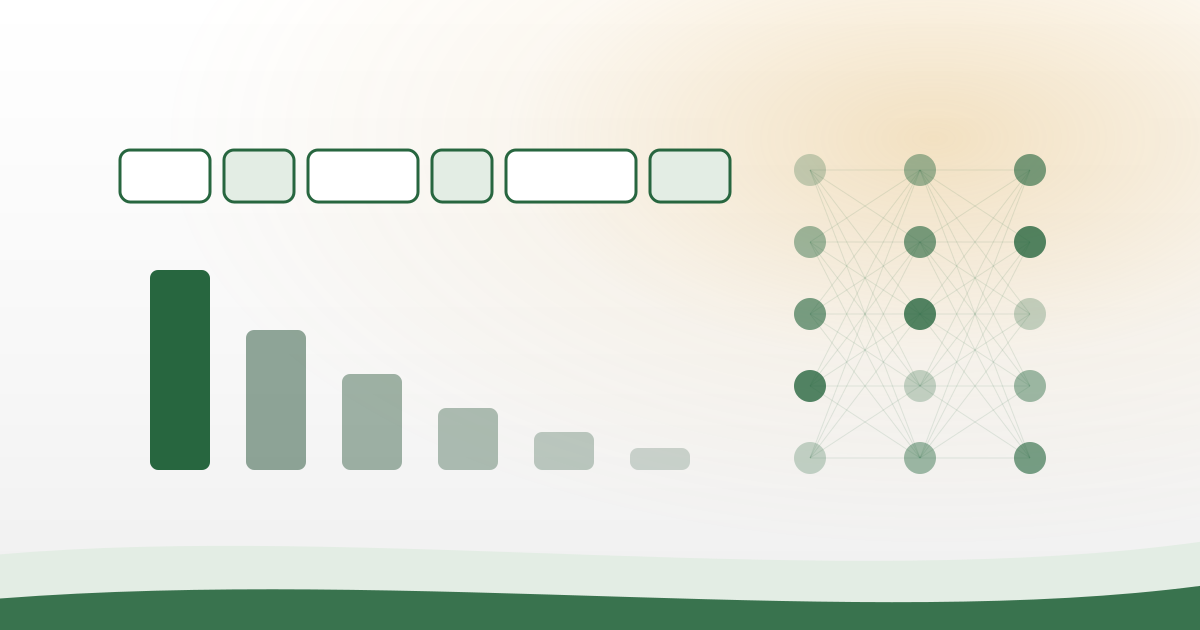
Before the app reads your question, your sentence is chopped up. Each small piece is called a token.
A short, common English word is usually one piece. The word “school” is one piece. The word “the” is one piece.
A long or unusual word is different. A rare name or a long technical word gets broken into several pieces. The app never sees the word the way your eye sees it. It sees the pieces.
Think of a shopkeeper selling rice. He never counts single grains. He works in scoops, and every sale he makes is in scoops. A token is the machine’s scoop.
Some tools show you a token count for a chat. That number is not a word count. It counts these pieces, and a long name counts for more than a short one.
Hold on to that fact. It comes back later, and it explains the strangest mistake these apps make.
Hindi costs more pieces than English
Here is the part that costs you real messages. The same sentence written in Devanagari usually becomes about three to four times more tokens than in English. That was the measured picture when this lesson was checked in August 2026.
So a long Hindi document fills the app’s working memory much faster. Your free message limit also runs out faster. The lesson on why it forgets what you said explains that memory in full.
This is not a fault in Hindi. It is a choice about how the cutting was designed. Newer designs make far fewer pieces for Indian languages, so the gap is shrinking.
Which script suits which task is a real decision, not a small one. Using AI in Hindi walks through it.
Predict, pick, repeat
Now the loop itself. It has three steps and it never changes.
First it predicts. Looking at everything so far, it works out a score for every piece that could come next. A few pieces score high. Most score close to zero.
Then it picks one of the high scoring tokens. Then it adds that piece to the text and starts the whole thing again. Predict, pick, repeat.
That is why the answer appears on your screen bit by bit. It is being written in front of you, not fetched from a shelf.
Try one line and watch the loop work.
Complete this sentence and then stop:
The capital of Uttar Pradesh is
Almost every time you will get Lucknow. It did not open a book of state capitals. In everything it has read, that piece follows those words far more often than anything else. A very strong pattern and a checked fact look identical from inside the loop.
Now run a second line and watch the same loop on a pattern you already know.
Complete the next line and then stop:
Monday, Tuesday, Wednesday,
You will very likely get Thursday. No calendar was opened here either. Those tokens have followed each other in writing more times than anyone can count. The loop simply continued the strongest pattern it could see.
Now take the pattern away.
Complete this line and then stop:
The three biggest shops in my village are
It has never read one word about your village. There is no strong pattern to continue. Some apps will say they cannot know that, and that is the honest answer. Many will simply write three shop names, because shop names are what fits after those words.
That is the whole lesson in three prompts. Where a strong pattern exists, the answer is usually right. Where none exists, an answer still arrives, in the same calm voice.
Because it picks from a list, the same question can come back a little different next time. Why the same question gives different answers covers that properly.
One honest warning about this picture. Being trained to guess the next piece does not mean it is blind to what comes later. Researchers who looked inside these models found them choosing a target word several words ahead. So it is trained like autocomplete, but it behaves like something with a small plan.
It writes what fits, even when it does not know
This is the sentence worth carrying out of the lesson. At every step the machine produces something that fits. Fitting and knowing are two different things.
There is no moment where it opens a store of facts and checks. Nothing inside it is kept word for word. It rebuilds text from patterns, every single time.
So a made up phone number sits in exactly the same shape as a real one. An invented website address looks just like a working one. To the machine, both simply fit.
This is also the clearest reason it is not Google. A search engine keeps a list of real pages and hands you the address of one. This machine keeps no such list. Ask it for the source of an answer it wrote from memory, and it may write a source that only looks real.
Some apps can search the web when you allow it, and then they show you what they found. How it searches, sees and uses tools explains when that is happening and when it is not.
Think of an exam with no negative marking. A student who does not know still writes something, because a blank scores zero and a guess might not. These models were graded much the same way while they were built. So they guess instead of staying quiet. Why AI makes things up goes deeper into this habit.
Test it yourself with one word
Open your app and type this.
How many times does the letter a appear in the word Muzaffarnagar?Now count it on paper yourself. The answer is four. The app often gets this wrong, and it sounds equally sure either way. If it gets your word right, that does not mean it can see the letters. Try a longer or stranger word.
You now know why. It never received the letters. It received a few pieces, and the letters are buried inside them. It is like asking someone to count letters in a word they only heard, never saw.
There is a partial trick. Ask it to write the word out with a space between every letter first.
Write the word Muzaffarnagar with one space between every letter.
Then count how many times the letter a appears in it.
Spacing the letters out turns each letter into its own piece. It often does better this way. Checking the count is still your job, not its job.
Three things you can now guess about it
Be clear about one thing first. This is not a small fault that somebody forgot to fix. It follows from the way the whole machine is built. Cutting text into pieces is what lets it read and write at all.
Once you accept that, you can predict its behaviour without testing every task.
It is weak at counting letters. Spelling puzzles, letter counts and word games sit right on its blind spot. The same weakness shows up in questions about the third letter of a word, or about which letter comes twice. If the task depends on the letters themselves, do that part on paper.
It is weak at exact arithmetic. It never saw your digits the way you write them on paper. Why it gets sums wrong shows what to do instead of trusting the number.
There is a good way to use it on sums anyway. Ask it to explain the method in steps, then work the digits yourself. The method is a pattern, so that is its strong side. The digits are not. Seven ways to check a maths answer gives you checks that need no tool at all.
It is strong at continuing a pattern. Give it one sample application letter and ask for another like it. Give it three exam questions and ask for ten more of the same type. Pattern work is the exact job the loop was built for.
You can push that strength quite far. Show it the shape of a leave letter and ask for one for your own situation. Show it five lines you wrote yourself and ask for a sixth in the same style. The lesson on giving it your own book, notes or photo turns this into a routine you can use.
This is why the same app can feel clever and foolish within one minute. The skill and the weakness grow from the same design. Once you know which is which, you stop being surprised and you start choosing tasks well.
One habit follows from all of this. Before you act on an answer, ask yourself a short question. Is this a pattern the machine has seen a thousand times, or a fact about my district, my exam or my office? Patterns are its strong ground. Your own particular facts are not.
For those facts, the official website or the office itself is still the source. The two-chat test and three other checks shows how to test an answer before you act on it. Why it is weaker on Indian questions takes the same idea further.
None of this has to be taken on trust. Every claim here is something you can test on your own phone in a few minutes. Try the letter count. Then the days of the week. Then the shops in your village. Three small prompts, and the picture becomes yours.
That is what the machine does. The next lesson, how a model is made, shows how it learned to do it: reading, then practice, then correction.
Do this now
Make it count letters, then check it yourself
- Pick a long word you know how to spell that has the letter r in it more than once. A long district name works well.
- Open your AI app and ask how many times the letter r appears in that word.
- Write the word on paper. Count the letter r yourself. Note whether the app matched you.
- In the same chat, ask it to spell the word out one letter at a time and count again.
- Compare the two answers it gave. Write down which one matched your paper count.
Remember this much
- Your sentence is cut into small pieces called tokens before the app reads it.
- The loop never changes: predict, pick, repeat.
- It always writes something that fits. Fitting is not the same as knowing.
- The same sentence in Devanagari makes about three to four times more pieces.
- It cannot see the letters inside a word, so letter counts and exact sums are weak spots.
- It is strong wherever you give it a pattern to continue.
Questions people ask
How does ChatGPT work in simple words?
It writes an answer one small piece at a time. At every step it scores the pieces that could come next, picks one, adds it, and starts again. It is not searching for a stored answer anywhere.
What is a token in AI?
A token is one small piece of text after your sentence is chopped up. A short common English word is usually one piece. A long or unusual word becomes several pieces.
Why does AI get letter counting wrong?
Because it never receives the letters. It receives the pieces, and the letters are hidden inside them. Counting letters is like counting something you were never shown.
Is AI just autocomplete on my keyboard?
It is trained the same way, but it is not the same size. Your keyboard looks at the last word or two. An AI app looks at your whole chat and carries patterns from a huge amount of writing.
Will this problem be fixed in the next version?
Not fully, because it comes from the design itself. Cutting text into pieces is what lets the model read and write at all. Newer versions get better at hiding the problem, not at removing it.
Prices, free limits and app screens change often. The facts in this lesson were checked on 9 August 2026. If what you see on your phone looks different, trust your phone and read the idea, not the exact button name.