Lesson 59 of 64 Module 8: The machine behind the answer
Why is AI free, and who is really paying
After this lesson you can
- Explain who pays for the free AI you use.
- Read a free limit message and know when it comes back.
- Stop a free offer from becoming a monthly charge.
- Plan for the day the free plan gets smaller.
Read first: Which AI app should you use first
You have used an AI app for weeks and it has never asked you for money. Someone at home has asked you the obvious question. Is there a catch, and will it start charging one day?
Somebody is paying already, and it is not you. Knowing who pays tells you what can change.
Somebody is already paying for your answers
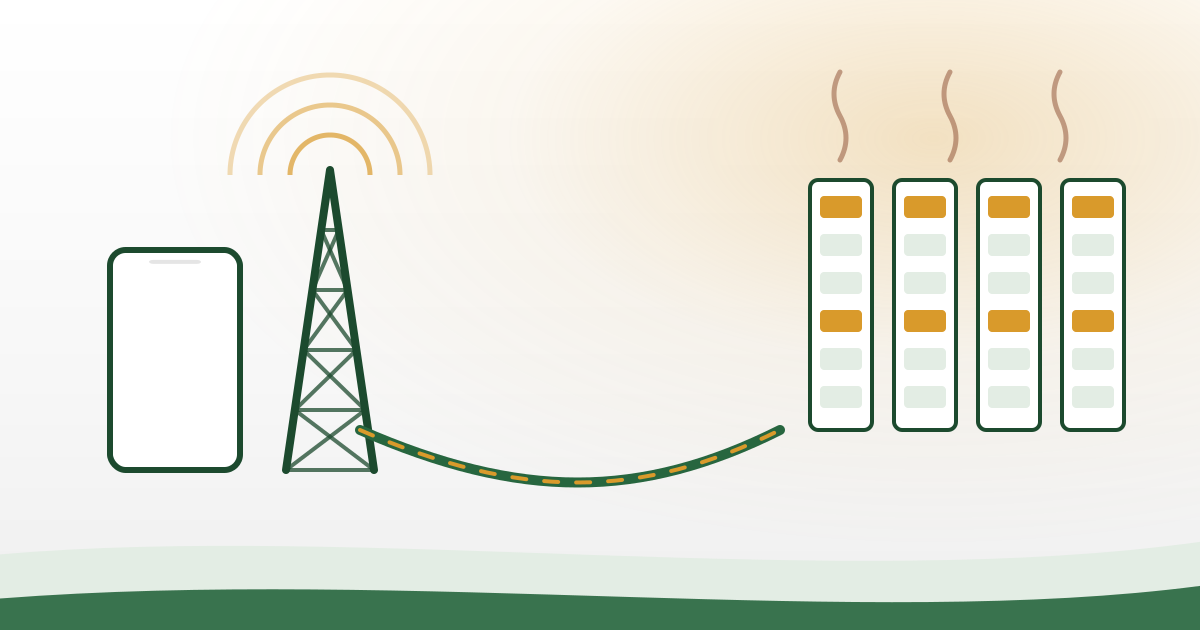
Every message you send costs the company money. Your question travels to a big machine room far away. It runs on very expensive chips, and that room uses electricity every second it is on. You can see what that building looks like in inside a data centre.
So a free app is not a cheap app. The money comes from two places.
The first is people who pay. A small share of users buy a monthly plan. Outside estimates for one big company put paying users near 50 million. Hundreds of millions more pay nothing at all. Those are estimates by other people, not published accounts.
The second is investors. The companies building AI are spending far more than they earn today. For 2026 the biggest of these companies together told investors they planned to spend hundreds of billions of dollars. Added up, that is roughly 60 lakh crore rupees in a single year.
Why spend that on people who pay nothing? Because nobody knows yet whose app people will use in ten years. The market is still being decided. Free use today builds a habit, and a habit is worth more to them than your few hundred rupees.
India matters a lot in that plan. One popular app is reported to have around 100 million users a week in India, and almost all of them use it free. The chain of companies behind all this spending is in who builds AI, and who pays.
So this is not charity, and it is not a trick. It is a business plan. Business plans change.
What free actually gives you
Free means a usable amount. It does not mean an unlimited amount.
Most free plans keep more than one budget. Chatting has one. Making pictures has another. Uploading a file, or asking the app to work through a spreadsheet, has another again. They run down separately.
That is mostly good news. A morning spent making pictures does not eat the chatting you needed. But it does mean you can hit a wall in one place while everything else still works.
There is one extra cost that nobody warns Indian readers about. The app does not read letters the way you do. It breaks your words into small pieces, and each piece is called a token. Hindi written in Devanagari takes about three to four times more tokens than the same sentence in English.
So the same question costs more in Hindi, and your free limit arrives sooner. If you are running short, type the question in English and ask for the answer in Hindi. Using AI in Hindi shows you how to do that well.
Nobody will tell you how many free messages you get
Search for the number and you will find very confident answers. Ten a day. A hundred a day. Ignore all of them.
The companies do not publish a fixed count. OpenAI, which makes ChatGPT, says only that free use is limited. It says the app will tell you when you reach the current limit, and when your access comes back. The word current is doing a lot of work in that sentence. The limit moves with demand.
So stop hunting for a number online. Read the message on your own screen instead. It gives you two things: that you are out, and when you can return.
Look for the time, not the count. Then write it down.
App:
Ran out at:
Comes back at:
What I was doing:
Keep that in your notes app for one week. After a week you will know your own real limit better than any website can tell you. You will also see your own pattern, and which kind of work runs out first for you.
If the wait is long, do not sit and stare at it. Move to your second free app and carry on working. Using AI without finishing your data has habits that stretch both your data pack and your limits.
The advertisement sitting next to your answer
Free is starting to mean something new as well. As checked on 9 August 2026, ChatGPT’s own help page says advertisements may appear in the free tier in certain countries. It does not say which countries.
So one day a small block may appear beside your answer, showing a product or a service. Here is the rule to hold on to. An advertisement next to an answer is not a recommendation from the AI. Somebody paid for that space.
Advertisements are not new to you. You see them in videos and inside apps every day. What is new is where this one sits. It sits right under an answer you asked for, wearing the same clothes as the answer.
Look for the small label. Paid space usually carries a word like sponsored or ad. Anything pushing you towards a payment page is selling, not advising. Fake AI apps and copied websites shows you what those pages look like.
Free for a year, then a charge appears
Telecom and technology companies in India have given away long free periods of AI plans that normally cost money. These offers are real. They are also temporary, and that is the part people forget.
Some of these offers ask you to save a way to pay before they start. That means a card, or a permission inside your UPI app that lets a company take money later. When you have saved one, that permission is the whole problem.
When the free period ends, the charge usually begins by itself. Nobody rings you first. Under India’s rules for automatic payments you should get a message before money leaves your account. So never swipe those messages away. But a small monthly amount goes out with no PIN and no OTP from you.
How to cancel, and when
Do this before you need it, not after. Go and look at the places money can leave from.
On an Android phone, open the app store and tap your account picture. Look for a section about payments and subscriptions. Then open your UPI app and look for a settings area about automatic payments. Both places show a list of what is set to take money from you.
Menu names change every year, so look for the words, not for a corner of the screen. Then follow three rules.
First, cancel where you bought it. If you started the plan inside the phone’s app store, cancel it there. If you started it on the company’s website, cancel it on that website. Cancelling in the wrong place feels like safety, and it is not.
Second, cancel a few days before the date, not on the date. Companies often take the money before the period actually ends. A cancellation on the last day can arrive too late.
Third, deleting the app cancels nothing. Emptying the bank account is worse than useless. A failed automatic payment can bring a fee from your own bank, so check your bank’s list of service charges rather than guessing.
| Where you started it | Where you cancel it |
|---|---|
| Inside the phone’s app store | The app store, under your account picture |
| On the company’s website | The same website, in your account settings |
| Through a phone company’s app | That app, and also your UPI automatic payments list |
One more thing surprises people. Cancelling a plan does not always remove the payment permission sitting in your UPI app. Check both lists, not one. And do not cancel a free offer months early just to feel safe. With a free offer, your access can stop the same day you cancel.
Nothing in this course needs a paid plan
Let us say it plainly. Everything taught in these lessons works on a free plan. Not one lesson asks you to spend money.
That is a choice, and there is a second reason for it. The price of this technology keeps falling fast. Work that cost real money two years ago is free today. If you wait, a paid feature usually turns up in the free plan.
So do not buy a plan because a video told you to. Buy one only if it earns you money this month. Cancel it in the month it stops.
Now prepare for the other direction too. Free plans can shrink, slow down or carry advertisements. Any offer with an end date will reach that end date. The way to survive all of this is boring, and it works.
Keep your own notes about what worked, in your own words. Learn the idea, not the button, because buttons move every few months. Keep a second free app ready, so that one company’s decision cannot stop your studying. Which AI app to use first will help you pick that second one.
That is also the argument of the next module. How fast this is changing shows how quickly names, prices and screens move, and what stays the same underneath. Before you go there, do the practice task below. Ten minutes with your subscriptions list is the cheapest ten minutes in this course.
Do this now
Find out what is already set to charge you
- Open the app store on your phone. Tap your account picture.
- Look for a section about payments and subscriptions, and open the list of subscriptions.
- Write down every item there, with the date of its next charge.
- Now open the UPI app you pay with. Look for a settings area about automatic payments.
- Write down anything listed there that you did not expect to see.
- Set a phone reminder four days before the next date on your list.
Remember this much
- Paying subscribers and investors cover the cost of free users.
- Free means a usable amount, not an unlimited amount.
- Chatting, pictures and file uploads each have their own budget.
- No company publishes a free message count. Read the message on your screen.
- An advertisement beside an answer is not the AI's advice.
- Cancel where you bought it, and cancel days before the date, not after.
Questions people ask
Why is ChatGPT free if it costs so much to run?
Because other people are covering your cost. A small share of users pay for a monthly plan, and investors pay for the rest. The companies are spending far more than they earn, because they want people to form a habit while the market is still being decided. Free use is part of the plan, not a mistake.
How many free messages do I get in a day?
Nobody can tell you, and any website that gives you a number is guessing. The companies do not publish a fixed count, and the real limit moves with demand. When you run out, the app tells you on the screen and shows when your access comes back. Read that message instead of searching.
Will the free AI plans stay free?
Some free level will almost certainly stay, because free users are how these companies grow. What is not safe is any particular limit or feature. Free plans can get smaller, slower or carry advertisements, and a free offer with an end date will end. Learn the skill, and keep a second free app ready.
Does the free plan show advertisements?
It can. As checked on 9 August 2026, ChatGPT's own help page says advertisements may appear in the free tier in certain countries, and it does not list which ones. If you see one, remember that it is paid space next to your answer. It is not the AI recommending anything to you.
How do I stop a free trial from charging me?
Cancel it a few days before the end date, in the same place where you started it. If you started it in the phone's app store, cancel it there. If you started it on a website, cancel it on that website. Deleting the app does not cancel anything, and letting the payment fail can bring a fee from your bank.
Prices, free limits and app screens change often. The facts in this lesson were checked on 9 August 2026. If what you see on your phone looks different, trust your phone and read the idea, not the exact button name.