Lesson 55 of 64 Module 8: The machine behind the answer
Inside a data centre: where your AI answer is made
After this lesson you can
- Describe what a data centre physically contains.
- Explain what a GPU does in plain words.
- Say why these chips are expensive.
- Name the Indian cities where most data centres are.
Read first: Where your question actually goes
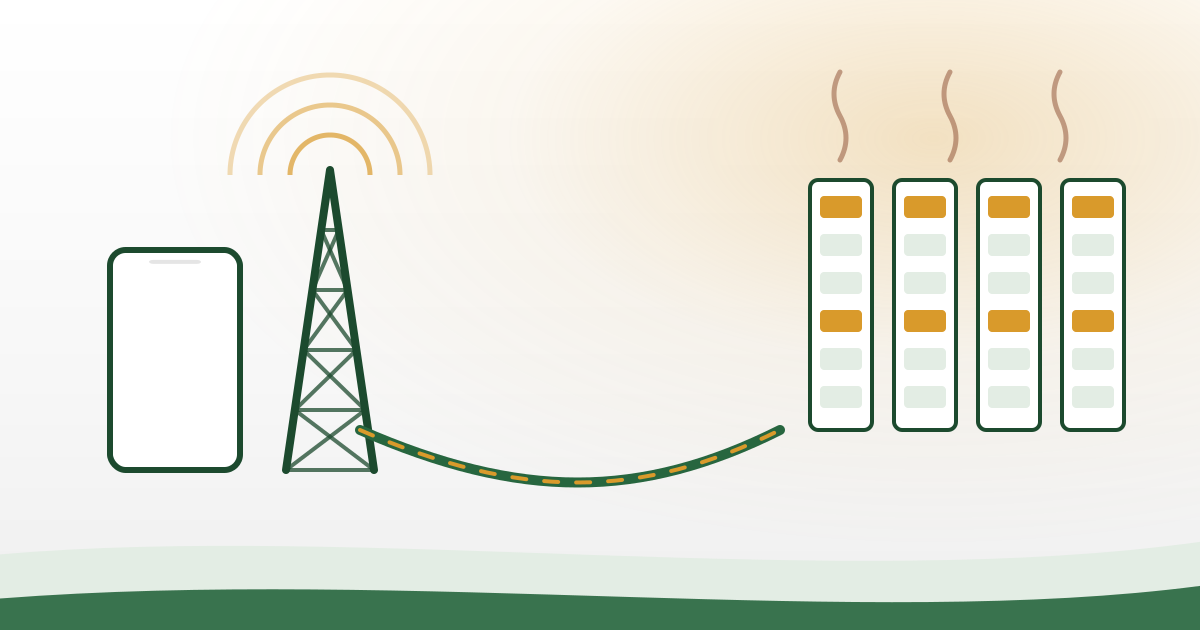
You press send. One second later, words start appearing on your screen. A machine you will never see did that work, and it is not inside your phone.
It sits in a building. This lesson walks you into that building.
What the building looks like
Picture a long, low building beside a highway. It has no windows. From outside it looks like a warehouse or a godown. There is a boundary wall, one gate and a guard. Nothing on the front tells you what is inside.
Inside there are almost no people. There are rows of tall steel cabinets, standing in straight lines like almirahs in a store room. Each cabinet is packed with computers. One hall can hold thousands of machines.
The first thing you would notice is the noise. Fans and pumps run all day and all night. The second thing is the air. It is cold, and it is being moved without a break. If the cooling stops for even a few minutes, the machines get too hot and shut down.
People call this “the cloud”. There is nothing cloudy about it. It is a building with a floor, a power line, a water connection and an electricity bill. Where your question actually goes follows the road from your phone to its gate.
What is inside one steel cabinet
Each steel cabinet is called a rack. A rack is only a frame. Machines slide into it, one above the other, like files on a shelf.
An ordinary rack holds many normal computers. They serve web pages, store files and run office software. A rack like that draws about as much power as ten village homes.
An AI rack is far heavier and far hungrier. One published design puts 72 specialised chips and 36 ordinary processors inside a single cabinet. They are wired together so tightly that they work as one large machine, not as 72 small ones. That cabinet weighs more than a small car.
The power is the part that surprises people. The design figure for one full cabinet is about 120 kilowatts. Engineers who install them report a little more than that when it is working hard. One full AI cabinet uses about as much power as a hundred village homes.
| Type of rack | Rough power draw | How it is cooled |
|---|---|---|
| Normal computers | about 12 kilowatts | air |
| Older AI chips | about 40 kilowatts | strong air |
| Newest AI cabinet | about 120 kilowatts | liquid piped to the chip |
That is roughly ten times more power in one cabinet, in one step of technology.
What a GPU actually does
Inside those cabinets sit the chips everyone argues about. A chip like this is called a GPU.
Here is the plain meaning. A GPU multiplies very large tables of numbers, and it does many thousands of those multiplications at the same moment. That is the whole trick. It is very fast at one narrow job.
It is not a brain and it does not know anything. An AI model is a huge collection of numbers saved as a file. Your question is turned into numbers too. Answering means pushing your numbers through the model’s numbers, multiplying and adding, until one more word comes out. Then the whole thing runs again for the next word.
Those stored numbers were set long before you typed. How a model is made covers where they came from. It is guessing the next word explains why the answer arrives one word at a time.
So this is what happens between your finger and the first word on screen. Your words travel to that building. A rack of these chips multiplies them through billions of stored numbers. The reply travels back down the same road.
Try this in any AI app and see if it can explain its own machine:
Explain in simple English what a GPU does inside an AI data centre.
Do not use the word brain anywhere.
Use one example about multiplication tables.
Keep it under 120 words.
A good answer says it multiplies large tables of numbers very fast, many at once. A weak answer calls it the brain of the computer and stops there. Four wrong ideas about AI deals with that brain picture properly.
Why the heat is the real problem
Almost all the electricity a chip uses turns into heat. The chip cannot hold it. The heat has to leave the room, or the machines fail.
Air can carry heat away up to a point. Above roughly 40 kilowatts in one cabinet, air is no longer enough. So the newest cabinets have liquid piped right up to the chips. For one full cabinet, engineers report about two litres of liquid moving every second.
Now imagine a hall full of those cabinets. Cooling is not a small detail here. It is a large part of the building, a large part of the cost, and a large part of the power bill.
In India the outside air is already hot for much of the year, which makes the job harder. It is also why many older buildings cannot take these new racks at all. New buildings are going up instead. What it costs in electricity and water looks at those numbers, and at the honest disagreement about them.
Why these chips cost so much
Two reasons work together, and you need both to understand the price.
The first is that they are genuinely hard to make. Very few factories in the world can make chips this fine. The last step is the tightest point of all. In that step, the chip and its fast memory are packed together onto one piece. As of early 2026, that packing capacity was reported as fully booked for the year.
The machines that print the finest patterns come from a single company in the Netherlands. Nobody can go around that queue by paying more.
The second reason is margin. The company that designs the most wanted AI chips keeps a large share of every sale. In the results it announced in May 2026, gross profit was close to 75 paise in every rupee of sales.
Scarcity on one side, a high margin on the other. That is the price, and there is no magic in it. Who builds AI, and who pays follows the chain from that machine in the Netherlands to your phone.
Where India’s data centres are
India is building these buildings too, not just America. Most live capacity sits around Mumbai, which held close to half of the country’s total in 2025. Chennai comes next, then the Delhi region and Hyderabad. Kolkata is smaller.
The country’s live capacity was about 1.6 gigawatts in 2025. In 2016 it was under 300 megawatts. More than 8 gigawatts of further capacity was in the pipeline, planned or being built.
AI is what drives that pipeline now. In 2024 roughly a quarter of the space rented out was for AI work. In 2025 it was over three quarters. That one jump explains why the building work suddenly got loud.
Large new campuses have been announced away from the old cities as well. One is at Visakhapatnam in Andhra Pradesh. Another is at Jamnagar in Gujarat. Running such a place is not only software work. Electricians, air-conditioning technicians, cable workers, civil workers and guards keep it alive.
India has a national AI programme called the IndiaAI Mission, approved by the government in 2024. It works in a way that surprises most people.
The government does not buy and own the chips itself. Instead it approves private companies that already run them in India. Then it pays part of the hourly rent. An Indian student, researcher or small company pays less for the same chip time.
Do not ask a chatbot for today’s rates or steps. Look for the programme’s own pages on a website whose address ends in gov.in, and check the date printed on the page. Providers, rates and application rules change every few months.
What to carry out of the building
The answer lands on your phone in one second. It came out of a building worth more than everything in your village put together. Steel, chips, power cables, pumps and water. That is worth knowing before you decide how far to trust what it says.
It also cuts the machine down to its real size. It is not a mind sitting somewhere, watching. It is arithmetic, done very fast, in a cold and very loud room.
One question is still open. How does your question travel from a tower near your village to that building? Most of that road is not in the sky at all. It lies on the floor of the sea. The cables under the sea is where this goes next.
Do this now
Ask the AI to describe a data centre, then mark its answer
- Open any AI app and start a fresh chat.
- Type: Describe what a data centre near Mumbai looks like inside. What is in one rack, and how is it cooled?
- Read the answer once. Then read this lesson again beside it.
- Mark each part of its answer as right, vague or wrong. Vague means it sounded confident but told you nothing you could check.
- Write one line in your notes about what it was vague on. Most answers go vague on power, cooling and Indian places.
Remember this much
- The cloud is a building. It has a gate, a power line and an electricity bill.
- A rack is a steel cabinet. One new AI rack can weigh more than a small car.
- A GPU multiplies huge tables of numbers, thousands at a time. It is not a brain.
- Almost all the electricity turns into heat, so cooling is a big part of the building.
- The chips cost a lot because very few factories can make them, and the designer keeps a high margin.
- In India most capacity sits around Mumbai, with Chennai, Delhi-NCR and Hyderabad growing fast.
Questions people ask
What is a data centre in simple words?
It is a building full of computers that other people use over the internet. It usually has no windows, a high wall and guards. Inside are rows of steel cabinets packed with machines, plus heavy cooling to carry the heat away. When an app says your data is in the cloud, it means a building like this.
What is a GPU and why does AI need it?
A GPU is a chip that multiplies very large tables of numbers, thousands of multiplications at the same time. An AI model is a huge pile of stored numbers, so answering your question is mostly multiplication. A normal processor can do the same sums, but far more slowly. That speed is the only reason GPUs are used.
Where are data centres located in India?
Most of India's live capacity is around Mumbai, which held close to half of it in 2025. Chennai, the Delhi region and Hyderabad come next, with Kolkata smaller. Large new AI campuses have been announced at Visakhapatnam in Andhra Pradesh and Jamnagar in Gujarat. These figures move every year, so check the date on any report you read.
Why are AI chips so expensive?
Two reasons together. Very few factories in the world can make chips this fine, and the last packing step was reported as fully booked through 2026. The company that designs the most wanted chips also keeps a large share of every sale as gross profit. Scarcity plus margin sets the price.
Does AI run on my phone or somewhere else?
For the big chat apps, somewhere else. Your phone only sends your words and shows the reply. Small models can be downloaded and run on a phone with no internet, but they are much weaker than the ones in a data centre. Anything that feels clever is almost certainly running in a building far away.
Prices, free limits and app screens change often. The facts in this lesson were checked on 9 August 2026. If what you see on your phone looks different, trust your phone and read the idea, not the exact button name.