Lesson 57 of 64 Module 8: The machine behind the answer
How much electricity and water does AI use?
After this lesson you can
- Compare the cost of a text answer, an image and a video.
- Put data centre electricity use in proportion.
- Explain why the published numbers disagree with each other.
- Make small choices that genuinely reduce waste.
Read first: Inside a data centre: where your AI answer is made
Last week you made ten pictures with AI, just to see what came out. Then a forwarded video told you that every AI question drinks a bottle of water. You cannot tell if that is true. Nobody in your street can tell you either.
Here are the numbers that are actually measured. Where they disagree, this lesson says so.
Text, picture and video are three different costs
Not every request costs the same. The gap is not small. It is the biggest thing on this page.
MIT Technology Review measured this on open models and published it in May 2025. Energy is counted in joules, the way weight is counted in grams. One short answer from a small text model used about 114 joules. One picture from a standard image model used about 2,282 joules. Five seconds of video used about 3.4 million joules.
Put that as a ladder.
| What you ask for | Energy, compared with one text answer |
|---|---|
| A typed answer | 1 |
| One picture | about 20 |
| Five seconds of video | tens of thousands |
One picture is worth roughly twenty text answers. One short video is worth more than a thousand pictures. The same work put that single video at about 0.94 kilowatt-hours. That is close to one full unit on a home electricity meter.
Model size matters too. In the same work, a much bigger text model used about 59 times more energy per answer than the small one. So the word “text” hides a wide range by itself.
So a whole evening of typing questions is cheap. A few videos made for fun are not.
One text answer really is small
It would be easy to frighten you now. That would also be dishonest.
Google measured its own Gemini app and published the result in August 2025, using data from May 2025. A middle-sized text prompt used 0.24 watt-hours of energy and 0.26 millilitres of water. That water is about five drops. Google’s own comparison was watching TV for less than nine seconds.
Epoch AI, an independent group, checked a different popular model in February 2025. It estimated about 0.3 watt-hours for a typical query. Two separate groups, two close numbers.
You will still see an old figure of 3 watt-hours per question. It came from a 2023 estimate that assumed very long answers and older chips. Epoch AI showed it was about ten times too high. It is still forwarded every day.
Long requests are the real exception. A question that makes the model work step by step can cost far more, from about 2.5 to 40 watt-hours in Epoch AI’s estimate. What thinking mode really does explains when that extra work is worth paying for.
Why no two numbers agree
One article says an AI question costs a few drops of water. Another says it costs half a litre. Both can be honest. They counted different things.
Google published two numbers for the very same prompt. The wider one, 0.24 watt-hours, counts the whole building. The narrow one, 0.10 watt-hours, counts only the chip doing the work. Same question, same day, different boundary.
There is a second reason. Only the company can see inside its own building. Everyone outside has to estimate from what the company chooses to publish.
The spread in published carbon figures is worse. Estimates for one query run from about 0.38 grams to about 68 grams. That is nearly two hundred times, and it is mostly a boundary argument.
Even the big totals disagree. Gartner and the IEA are both respected, and their figures for data centre electricity in 2025 sit about eight percent apart. Nobody has a meter on the whole world. These are estimates, made by careful people, using different rules.
So carry one question with you. What did they count? Chip only, or the whole building? One answer, or the training as well? That question sorts out most of the fighting online, and it will still work next year. Four wrong ideas about AI clears out other claims that travel the same way.
How much of the world’s electricity this is
Now step back from your own phone. All data centres together, not only the AI ones, used about 415 terawatt-hours in 2024. That was about 1.5 percent of the world’s electricity. The IEA published that in April 2025.
It is growing fast. The IEA’s main case reaches about 945 terawatt-hours by 2030, which is just under 3 percent of world electricity. Its range for 2035 runs from about 700 to over 1,700 terawatt-hours.
That wide range is not carelessness. It is an honest admission. Nobody knows yet how many of these buildings will get built.
The IEA gives one comparison worth remembering. A typical AI focused data centre uses about as much electricity as 100,000 homes. The largest ones now being built will use around twenty times that. One building, drawing the power of a small city.
Hold both facts together. A few percent of world electricity is a large amount of power. It is also not the main thing burning the planet.
Trained once, asked a billion times
There are two separate bills here, and people mix them up.
The first is building the model. That happens once and costs a huge amount. Epoch AI tracks these costs. A single training run for the biggest models has cost a few thousand crore rupees. How a model is made describes what that work involves.
Then comes a surprise. In Epoch AI’s breakdown, energy is only 2 to 6 percent of what training costs. Most of the money goes on chips and on people.
The second bill is answering. Each answer is tiny, as you saw above. But it happens billions of times a day, and it keeps happening for as long as the model is in use. Across a model’s whole life, the answering side is now the bigger ongoing cost.
Your chat sits on the answering side. So does everybody else’s. Small, multiplied by enormous.
Water, and why it matters more here
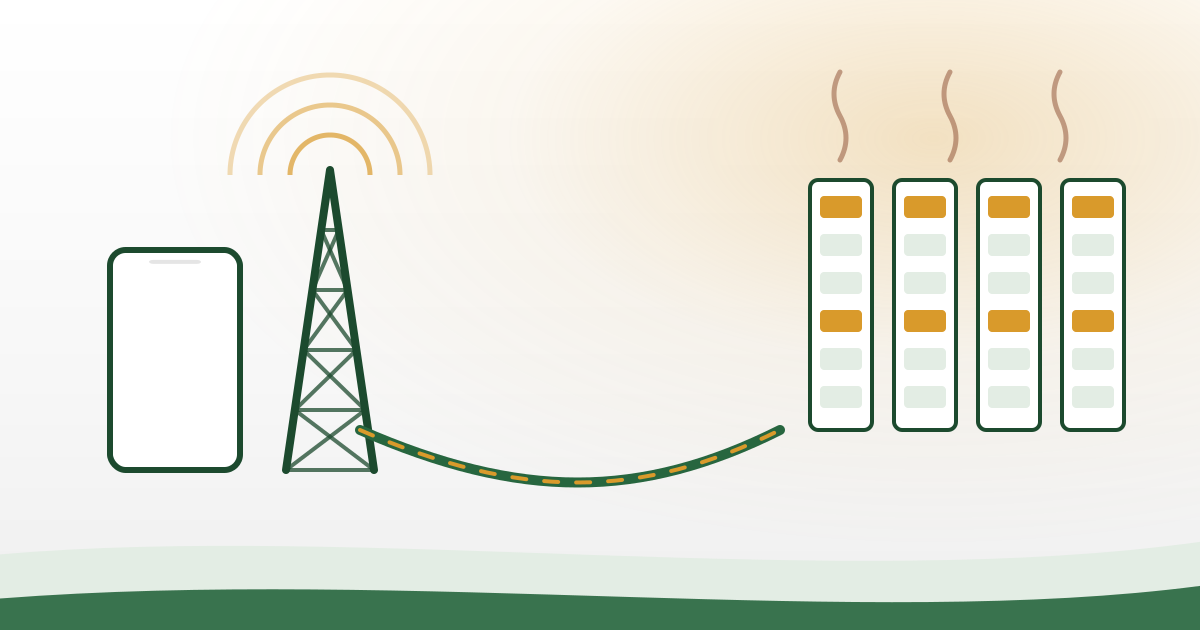
Chips get hot. The heat has to go somewhere, and many buildings send it away using water.
One common method sprays water and lets the air dry it. The heat leaves with the vapour, and that water does not come back. This is called evaporative cooling.
CEEW, an Indian research group, looked at this in January 2026. It estimated that a typical 100 megawatt site using this kind of cooling can use around 800,000 litres a day. In March 2026, Karnataka’s IT minister said each megawatt of data centre capacity needs about 2.5 crore litres a year.
This lands harder in India than in a cold country. CEEW notes that Indian data centres often use evaporative cooling, because it is hot here. It also notes that 57 percent of Indian districts face high or very high risk from extreme heat.
Not every site is the same. The newest racks run so hot that air cannot cool them. In those, a liquid is pumped right up to the chip. Cooling design differs from building to building, and water use differs with it. So no single figure fits the data centre near you. If one is proposed in your district, ask the operator which cooling it uses and how much water it will draw each day.
Both things can be true at once. These buildings bring electrical, cooling, security and civil work to a district. They also draw water in places where borewells already run low. A person who has watched a borewell fail is not wrong to ask the question.
The changes worth making
Start with the one that surprises people. The model does not read letters. It cuts your text into small pieces first, and each piece is called a token. Devanagari needs roughly three to four times more pieces than English for the same sentence.
So the same question costs several times more when you type it in Hindi script. One report in April 2026 put the English version at about a fifth of the cost. That is not your fault and it is not a reason to stop using Hindi. It does explain why free message limits finish faster. If yours run out early, type the request in English and ask for the answer in Hindi.
Answer in Hindi.
Explain in six short lines how to open a post office savings account.
Use simple words my mother will understand.
An AI answer about a bank or a post office is only a starting point. Check the papers needed at the counter itself. Understanding schemes, forms and offices shows what only the office can tell you.
Using AI in Hindi covers the rest of that habit.
Next, prefer words over pictures. If you want a diagram for your notebook, ask for a description and draw it yourself. That is better for your marks anyway, as Diagrams: it describes, you draw explains.
Do not make a picture.
Describe the poster in words, part by part.
I will draw it myself.
Then write one careful request instead of ten quick ones. Every rewrite is a fresh answer, paid for in full. How to ask so you get a useful answer is the whole skill in one lesson.
Write three short WhatsApp messages for my shop opening on Sunday.
Give all three in one answer.
Keep each message under 40 words.
Simple Hindi words, written in English letters.
Last, stop pressing the button that makes a new answer out of habit. If the answer is already good, keep it and save it. Using AI without finishing your data shows how to save instead of asking twice.
Now the honest ending. Your chats are not drying up your district. They are also not free. The building is real, the meter runs, and somebody pays the water bill. You have the proportion now, and you can judge it yourself.
That somebody is not you, which is worth thinking about. Who builds AI, and who pays follows that money next.
Do this now
Count what you made this week
- Open your AI app and scroll back through the last seven days of chats.
- Count three things separately: text answers, pictures you made, videos you made.
- Write the three counts in your notes app, one below the other.
- Now convert. Count each picture as about twenty text answers. Count each short video as about 30,000 text answers.
- Add up the three lines and see which one is biggest. Write down one habit you will change next week.
Remember this much
- Text is cheap. One picture is worth about twenty text answers. A few seconds of video is worth tens of thousands.
- One text answer really is small. Google measured a middle prompt at 0.24 watt-hours and about five drops of water.
- Ask one question of every number you read about AI: what did they count?
- All data centres together were about 1.5 percent of world electricity in 2024, heading for about 3 percent by 2030.
- Cooling water is the part that touches an Indian district. It varies by site, so ask about the site near you.
- Over a model's life, answering costs more than training, because answering happens billions of times.
Questions people ask
How much electricity does one AI question use?
For a normal typed question, very little. Google measured a middle-sized text prompt in its own app at 0.24 watt-hours, using data from May 2025. Epoch AI independently estimated about 0.3 watt-hours for a query on another popular model. Long step-by-step reasoning requests cost much more than that.
Is AI bad for the environment?
It has a real cost, and it is not the largest cost in the world. All data centres together used about 1.5 percent of world electricity in 2024, and the IEA expects that to reach roughly 3 percent by 2030. The honest position sits between panic and dismissal. Your own chats are a very small part of it.
How much water does an AI data centre use?
It depends on how the building is cooled, which is why the numbers differ so much. CEEW estimated in January 2026 that a typical 100 megawatt site using evaporative cooling can use around 800,000 litres a day. Other cooling designs use far less water. If a site is planned in your district, ask the operator which design it uses.
Does making AI pictures use more power than text?
Yes, many times more. In measurements published by MIT Technology Review in May 2025, one picture from a standard image model cost about twenty times a short text answer. A five second video cost more than a thousand times that picture. If you want to cut waste, cut video first and pictures second.
Does asking in Hindi cost more than asking in English?
Yes. The model cuts text into small pieces, and Devanagari needs roughly three to four times more pieces than English for the same sentence. One report in April 2026 put the English version at about a fifth of the cost. If your free messages run out early, type the question in English and ask for the answer in Hindi.
Prices, free limits and app screens change often. The facts in this lesson were checked on 9 August 2026. If what you see on your phone looks different, trust your phone and read the idea, not the exact button name.