Lesson 54 of 64 Module 8: The machine behind the answer
Where your question actually goes
After this lesson you can
- Trace the path of your question step by step.
- Explain why an answer takes a moment to arrive.
- Understand what your phone is and is not doing.
- See why a cut cable far away can affect you.
Read first: It is guessing the next word
It is late and the room is quiet. You type a question into an AI app and the answer begins to appear. It feels like your phone is thinking hard for you.
Your phone is doing almost none of the work. This lesson follows your question to the place where the work really happens.
Your phone is only a messenger
Your phone has two small jobs here. It sends your words out. Then it shows the words that come back.
The model itself is not on your phone. It sits in a machine that may be thousands of kilometres away. Your phone never holds it, never stores it and never runs it.
You can test this in ten seconds. Turn off mobile data and ask the app anything at all. Nothing comes back, because there was nothing on your phone to answer with.
Almost every one of us reaches that far machine through a mobile tower. In TRAI figures for June 2026, India had about 1,300 million wireless connections. Wired broadband connections were under 48 million.
So for nearly all of us the journey starts at a tower, not at a wire in the house. If your daily pack is small, using AI without finishing your data is worth reading beside this lesson.
The same figures show the village still sits behind the city. In rural India there were about 61 phone connections for every 100 people. In cities there were more than 150. Fewer connections in the village, but the same road out of it.
Follow one question, step by step
Now walk beside one question and watch each step.
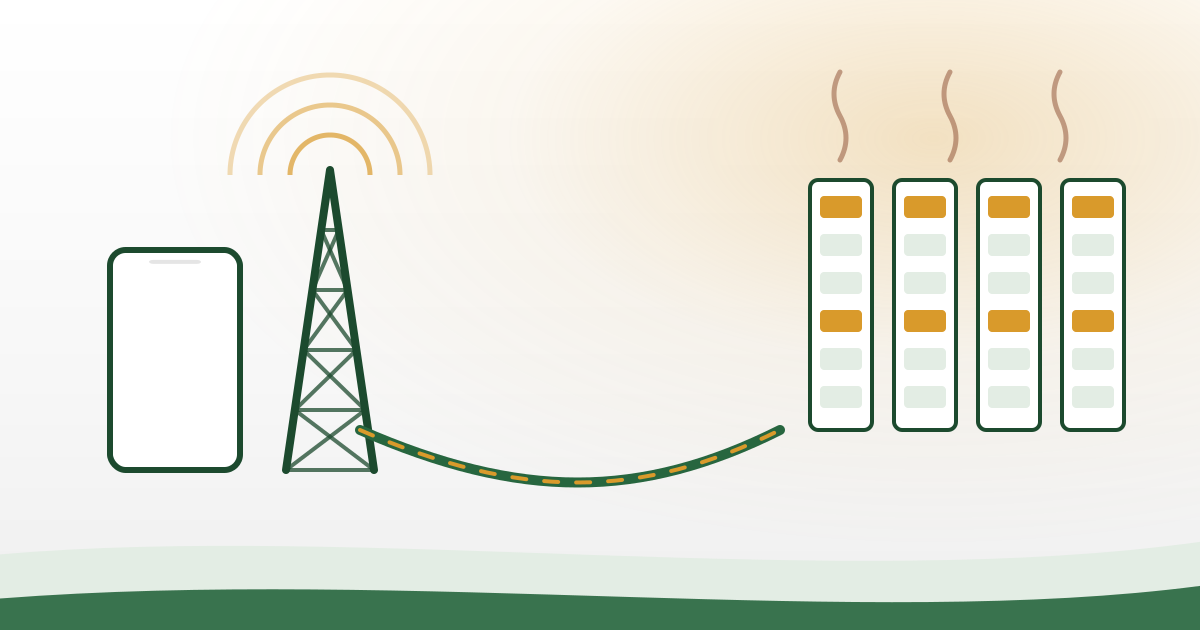
Your phone turns your words into a radio signal. The nearest mobile tower picks that signal up. That tower may be one street away or a few kilometres away.
A fibre cable runs from the tower into the ground. Your question now travels as light inside thin glass.
That cable joins a bigger city network. Your operator carries the question onward to a large building where many networks meet and hand traffic to each other. That meeting place is called an exchange.
If the machine you need sits outside India, your question goes to the coast. It reaches a landing station, which is where sea cables come ashore. India had 26 landing stations when this was counted in July 2026, mostly near Mumbai and Chennai.
Then it goes under the sea. More than 99 percent of data moving between continents travels through cables on the sea floor. The bundle of glass fibres inside one is no wider than a garden hose.
At the far end it comes ashore again, crosses another network, and reaches a building full of machines. Your answer is produced there. Then the whole road runs backwards to your hand.
| Step | What happens |
|---|---|
| 1 | Your phone sends your words as a radio signal |
| 2 | The nearest mobile tower picks the signal up |
| 3 | A fibre cable carries it away from the tower |
| 4 | A city network moves it onward |
| 5 | An exchange hands it to another network |
| 6 | A landing station puts it into a sea cable |
| 7 | A building of machines produces your answer |
One part of this may surprise you. Airtel and Jio are not only phone companies. They own pieces of the sea road as well.
Airtel is the landing party for both Indian landings of a cable called SEA-ME-WE-6. That cable runs about 19,200 km between Europe and Asia. Jio runs a landing station at Versova in Mumbai. So the company on your SIM may own part of the road your question takes.
That one cable links more than 20 countries, from France to Singapore. Jio lands another cable at Chennai. Tata Communications runs landing stations at Mumbai, Chennai and Cochin. BSNL runs one at Tuticorin.
The June 2026 figures give Jio about 39 percent of wireless connections and Airtel about 38 percent. So for most people reading this, the SIM in the phone belongs to a company that owns a piece of the sea road.
Why the answer is never instant
Light inside fibre is fast. It is not infinitely fast. Light covers about 200,000 kilometres every second inside glass.
Suppose the machine is 10,000 km away. Your question goes there and the answer comes back. That is 20,000 km, so the travel alone takes roughly a tenth of a second.
Nothing has been worked out yet at that point. That fraction of a second is only the road.
Every step adds a little more delay on top. The tower adds a little. Each exchange adds a little. Every machine that reads the address and passes the message on adds a little.
Google publishes a public list of the places where its computing sits. On 23 July 2026 that list showed 43 regions and 130 zones. So your question does not go just anywhere. It goes to one of a few dozen buildings on earth, often not in India.
An app that talks to you in Hindi is not proof that the machine is in India. The language on the screen tells you nothing about where the answer was made. Most big chat apps today do that work outside the country.
That is why a reply can feel slightly slow even on a strong 4G signal. Distance has a floor, and no engineer can remove it.
Inference is the name for this
The model has two very different lives, and they are easy to mix up.
Long before you opened the app, the model was built. It read enormous amounts of text and was corrected many times. That building work is called training. It happened once, it took months, and it is finished.
What happens when you press send is a different thing. The finished model is run on your words to produce one answer. Running it like that is called inference.
Training is over for that model. Inference happens every time anyone anywhere asks anything. That is the honest reason a free app still costs the company money on every single message.
If the training side is not clear yet, how a model is made covers it properly.
Look at your screen carefully next time. The answer does not appear all at once. It arrives in small pieces, from left to right.
That is not a display trick to keep you interested. The answer is being produced one piece at a time in that far building, while you wait. Each piece is sent to your phone as soon as it is made.
This is the guessing loop from how AI predicts the next word, happening in front of you. Predict, pick, repeat, and the road back carries each piece to your screen.
Try this one and keep your eyes on the screen.
Write one paragraph of about 120 words on why fibre cables
carry more information than copper wires.
Use simple English.
The first words usually appear well before the answer is finished. First a few words, then a line, then the rest. It never lands as a finished block.
Sometimes the app pauses first and shows nothing for a while. In many apps that pause means it is working through the problem before it writes. What thinking mode really does explains when that is worth the wait.
When a cable breaks, your village feels it
Sea cables are built strong, but the sea is busy. Ships drop anchors and anchors drag along the sea floor. Plain accidents cut cables too.
A cut at sea is much harder to reach. A special repair ship has to sail out, find the cable, lift it and join it again.
Cuts in the Red Sea in February 2024 took months to repair. During a repair like that, traffic has to squeeze through other cables, and services slow down far away.
So a break thousands of kilometres from your district can slow an app in your hand. When something feels slow, the fault may not be your phone or your pack at all. When the app does not work helps you tell the two apart.
This is also why the word cloud is worth throwing away. Cloud is a marketing word. There is no cloud in the sky holding your chat.
The real thing can be counted. One count on 2 July 2026 listed 603 sea cables in service around the world. Another 91 were planned or being built. Those cables come ashore at 1,893 landing stations.
A cloud cannot be counted like that. Landing stations can. Each of those 1,893 places is a real spot on a real coast. Somebody owns the land under it. Somebody pays its electricity bill. Somebody drives out at night when a machine there stops working.
India holds 26 of those 1,893 landing stations. Every one of them is a place you could drive to.
A small model can live inside your phone
There is one real exception to everything above. A small model can be downloaded onto a phone and run right there, with no internet at all.
These small models are much smaller than the one behind your usual app. Models of roughly one to four billion numbers are the practical size for a phone today. Apps built for this include Google’s AI Edge Gallery, PocketPal AI and MLC Chat.
Be honest with yourself about what you get. A small offline model gives shorter and weaker answers, and it is wrong more often. It also heats the phone and drains the battery.
There is one thing a small model does not have to do. It sends nothing anywhere. No tower, no exchange, no sea cable. The whole travel part of the wait is gone.
Even so, it works during a power cut and with an empty data pack. That is a real thing to own. Running a model on your own machine goes into it in module 9.
What is inside that building
You now know the whole road your question travels. The last stop is still a closed box in your mind.
That last stop is usually a windowless building with rows of steel cabinets inside. One modern cabinet can hold dozens of chips, weigh more than a small car, and draw as much power as a hundred village homes. It needs liquid pumped through it just to stay cool.
The next lesson, inside a data centre, takes you into that building. The sea part of the road gets its own lesson too, in the cables under the sea.
Do this now
Watch one answer arrive, piece by piece
- Open your AI app where the signal is good. Ask it to write one paragraph of about 150 words on any topic you like.
- Keep your eyes on the screen while it answers. Notice that words arrive in pieces, not all at once.
- Count slowly from the moment you press send until the first words appear. That short wait includes the journey there and back.
- Now turn off mobile data and ask the same question again. Note what comes back.
- Turn data on again. Write two lines in your notes app: what your phone did, and what the far machine did.
Remember this much
- Your phone only sends words out and shows words coming back.
- The road runs phone, tower, fibre, city network, exchange, sea cable, building.
- Running the finished model on your question is called inference.
- Light in fibre is fast but not instant, so distance sets a floor on speed.
- Cables at sea get cut, and repair ships take a long time.
- There is no cloud. There are buildings, cables and electricity bills.
Questions people ask
Where does ChatGPT actually run?
It runs on computers inside a data centre, not on your phone. Those buildings sit in a few dozen places around the world, and often not in India. Your phone only sends your words and shows the reply.
Why does AI take a few seconds to answer?
Part of the wait is travel. Your question has to reach a machine that may be thousands of kilometres away, and the answer has to come back. The rest of the wait is the machine writing your answer one piece at a time.
What is inference in AI?
Inference is the machine running a finished model on your question to produce an answer. It happens every time you press send. It is different from training, which built the model once, long before you opened the app.
Can AI work without internet?
A big AI app cannot. A small model can be downloaded and run on a phone with no internet at all. It is much weaker than the app you use online, but it still works during a power cut or with no data left.
Why is my internet slow when my phone is fine?
The problem may be far from you. A cable cut at sea or a busy network in another country can slow a service in India. Repairs at sea need a special ship and can take a long time.
Prices, free limits and app screens change often. The facts in this lesson were checked on 9 August 2026. If what you see on your phone looks different, trust your phone and read the idea, not the exact button name.